

AI in Healthcare Staffing: Helpful Tool or Just Another Buzzword?

Healthcare staffing agency using technology and AI tools to improve nurse scheduling, reduce staffing shortages, and support efficient workforce management in nursing homes and healthcare facilities.
Let’s be honest — the second people hear “AI in healthcare,” the reactions split fast.
Some folks picture robots taking over jobs.
Others think it’s just another fancy word for software nobody asked for.
And nurses? Nurses are usually wondering if it’s going to make their day easier… or just add another app to log into.
Fair questions.
The truth sits somewhere in the middle.
What AI Actually Does in Staffing (No Sci-Fi Required)
AI isn’t walking the halls or passing meds. In staffing, it’s mostly doing the behind-the-scenes work that humans are tired of doing manually.
Think:
matching clinicians to shifts faster
flagging schedule gaps before they become emergencies
tracking credentials and expirations
reducing last-minute chaos
In other words, AI handles the admin mess, not the human care.
What AI Can’t Replace
Let’s be clear about this part.
AI can’t:
understand when a nurse is burned out but still showing up
read the tone behind “I guess I can pick up”
build trust with a facility team
advocate when expectations aren’t realistic
That still takes people. Real ones.
Technology can organize information. It can’t replace judgment, empathy, or experience.
When Tech Actually Helps Nurses
AI works best when it’s used as a support tool, not a control mechanism.
When done right, technology can:
reduce back-and-forth scheduling texts
speed up placements
eliminate paperwork headaches
give clinicians more control over when and where they work
The goal isn’t to push nurses harder.
It’s to give them breathing room.
The Problem With Tech for Tech’s Sake
Here’s where things go sideways sometimes.
When systems are built without nurses in mind, they become:
clunky
impersonal
frustrating
Technology shouldn’t feel like another shift. If it does, it’s not doing its job.
The best staffing tech is almost invisible — it works quietly so people can focus on care.
So Is AI the Future of Staffing?
AI is part of the future — but it’s not the center of it.
The future of healthcare staffing still depends on:
relationships
communication
respect for clinicians’ time and limits
realistic expectations
Technology should support those things, not replace them.
The Bottom Line
AI isn’t here to replace nurses.
It’s here to replace inefficiency.
When staffing agencies use technology thoughtfully, it can:
reduce burnout
improve response times
support flexibility
and make staffing feel less reactive
That’s not hype. That’s progress — when people stay at the center of it.
The Most Dangerous Phrase in Healthcare: “It Should Be Fine”
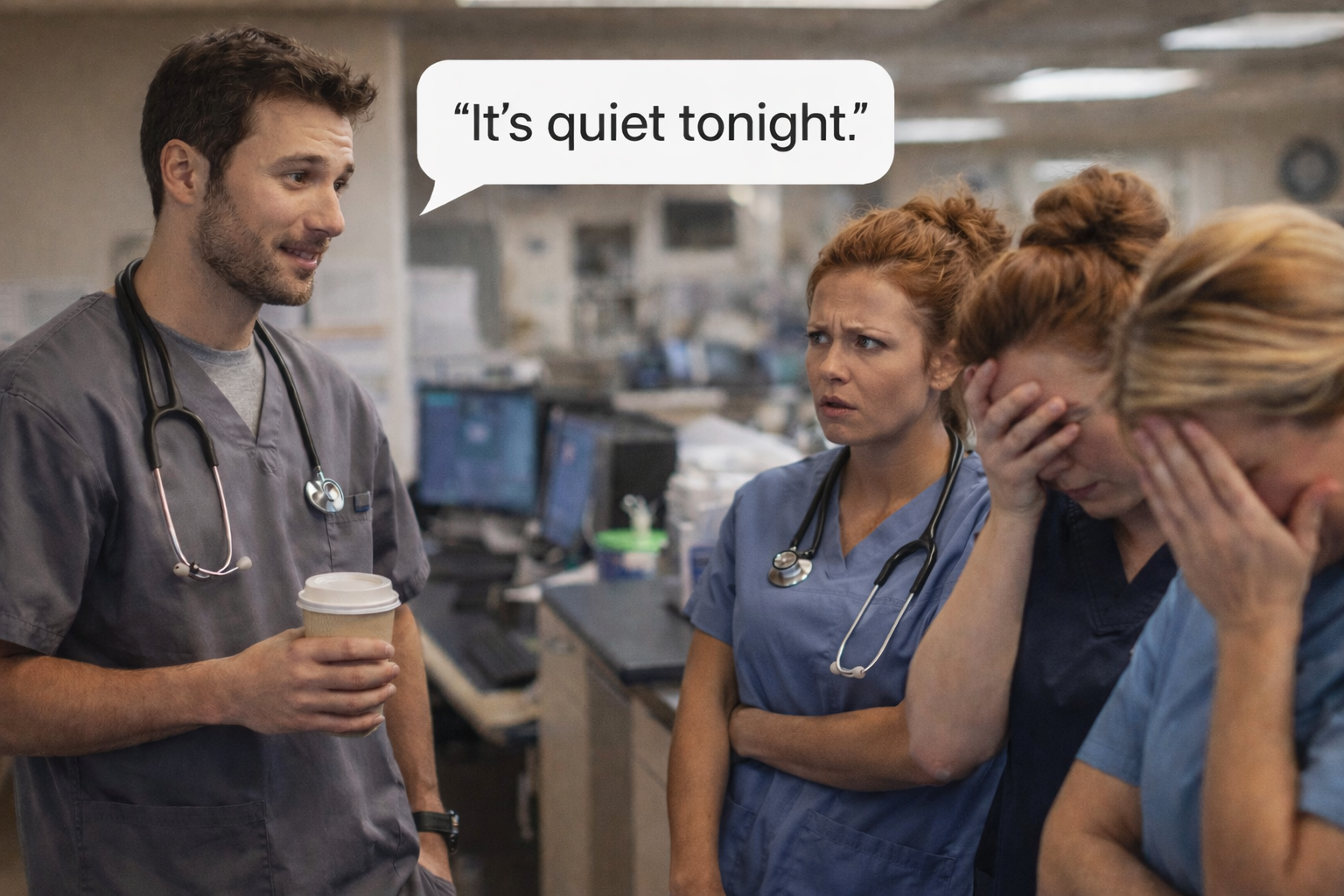
Nurse reacts in disbelief after a coworker says ‘It’s quiet tonight’ at a hospital nurse’s station, while other nurses cover their faces in shared panic.
Every profession has its red flags.
In healthcare, one phrase has quietly earned legendary status — not because it brings comfort, but because it almost never tells the truth.
“It should be fine.”
If you’ve been in healthcare longer than a week, you already know:
When someone says this, it is rarely fine.
When “It Should Be Fine” Usually Appears
This phrase doesn’t show up randomly. It arrives during very specific moments, like:
When staffing is just a little too tight
When someone called off and coverage is… optimistic
When a schedule looks okay on paper but feels shaky in real life
When everyone is hoping the day behaves itself
Hope is not a strategy — but healthcare has survived on it longer than we like to admit.
Translation Guide (Healthcare Edition)
“It should be fine.”
Translation: We’re about to find out together.
“It should be fine — it’s a light day.”
Translation: Someone just said the Q-word.
“It should be fine, we’ve done worse.”
Translation: We are emotionally preparing.
“It should be fine, it’s only temporary.”
Translation: Temporary has been six months.
Why This Phrase Won’t Retire
Healthcare is unpredictable by nature. People don’t get sick on schedule. Emergencies don’t RSVP. And staffing plans don’t always survive contact with reality.
So instead of certainty, the industry leans on reassurance.
Sometimes it works.
Sometimes it doesn’t.
But the phrase sticks around because it fills the gap between what we hope happens and what we can actually guarantee.
Where Staffing Comes In (Without the Drama)
This is where good staffing support matters — not as a miracle solution, but as a stabilizer.
When staffing is handled thoughtfully:
fewer “fingers crossed” moments happen
backup plans actually exist
nurses aren’t left holding everything together alone
facilities don’t have to gamble on “fine”
The goal isn’t perfection.
It’s predictability.
A Little Humor, A Lot of Truth
Healthcare professionals don’t expect every day to be smooth. They understand the work comes with challenges.
What they do deserve is honesty, preparation, and support — not a shrug and a hopeful sentence.
So the next time someone says, “It should be fine,”
maybe double-check the plan.
Just in case.
From Shamrocks to Smiles: Celebrating St. Patrick’s Day Together

Children reading a book to elderly residents in a nursing home during a St. Patrick’s Day celebration, with nurses nearby, highlighting intergenerational connection, dementia-friendly activities, and compassionate long-term care.
In long-term care communities, holidays are not just dates on a calendar. They are moments.
St. Patrick’s Day brings green decorations, shamrocks taped to doors, and a little extra buzz in the halls. Residents wear their green. Staff lean into the fun. Families stop by when they can. And for a day, things feel lighter.
Those moments matter more than people realize.
Why the “Little Things” Matter So Much
For residents, especially those living with Alzheimer’s or dementia, familiar traditions can spark comfort, joy, and connection. A holiday song. A shared laugh. A simple activity that breaks the routine.
Even small celebrations help anchor the day in something positive.
It is not about how big the event is. It is about how it makes people feel.
The Power of Reading and Shared Moments
Sometimes, the most meaningful moments do not come from decorations or treats at all.
Reading aloud, especially familiar or playful stories, has been shown to bring calm, recognition, and happiness to many residents. Children reading to residents, staff sharing stories, or families sitting together with a book can create powerful connections, particularly for those with memory loss.
Even though Dr. Seuss Day may have passed, the spirit behind it does not have an expiration date.
Rhymes, repetition, and storytelling can:
stimulate memory
reduce anxiety
encourage engagement
create moments of joy
For some residents, it is not about remembering the story. It is about feeling included in it.
Care Is More Than Clinical
Healthcare often focuses on what must be done. Medications, schedules, charting. But care also lives in the in-between moments.
It lives in:
laughter in a common room
a story read out loud
a holiday celebrated together
a smile that was not there an hour ago
These are the moments families remember. These are the moments residents feel.
Celebrating Together
St. Patrick’s Day is a reminder that community matters. That joy can be created with simple things. And that caring for people means caring for their spirits, not just their needs.
From shamrocks to smiles, these moments, big or small, are what make care feel like home.
Nurses Aren’t Leaving Healthcare. Healthcare Is Leaving Nurses.

Tired nurse sitting in her car after a hospital shift, reflecting on burnout, workforce challenges, and the emotional realities of modern healthcare
There’s a moment most nurses know too well.
It’s sitting in the car before a shift, hands still on the steering wheel, staring at the building like it might blink first.
It’s checking your phone and seeing “Can you pick up?” pop up again — even though you already gave everything yesterday.
It’s loving the work, but quietly wondering how much longer your body, your mind, or your heart can keep up.
That’s not burnout because nurses don’t care.
That’s burnout because they care too much — in systems that don’t always care back.
Let’s clear something up.
Nurses aren’t disappearing.
They’re opting out of environments that drain them without protecting them.
We keep calling it a “nursing shortage,” but the truth is harder and more honest:
There are nurses. They’re just tired of being treated like coverage instead of professionals.
Technology Can’t Fix a Broken Relationship
Healthcare loves a shiny solution.
AI scheduling. Automation. Predictive staffing models. New platforms that promise to fix everything.
And listen — technology has its place. It can move faster. It can organize chaos. It can help match people to shifts more efficiently.
But here’s the part no system can automate:
You can’t optimize human beings who are already exhausted.
If the relationship between caregivers and the system is broken, no software update is going to fix that. Tools don’t build trust. People do.
Flexibility Isn’t a Perk — It’s Survival
Somewhere along the way, flexibility got framed like a luxury.
But for nurses?
It’s how they stay in the profession at all.
Per diem work. Self-scheduling. Choosing when and where to give care. These aren’t signs of a weak workforce — they’re signs of professionals setting boundaries so they can keep showing up.
Autonomy isn’t rebellion.
It’s sustainability.
What Nurses Are Actually Asking For
Despite what the noise says, nurses aren’t asking for the impossible.
They’re asking for:
predictable schedules
fair pay for real responsibility
respect for their credentials and experience
to be treated like humans, not last-minute solutions
That’s it. Not applause. Not pizza parties. Just dignity and consistency.
Where Staffing Agencies Should Come In
Staffing agencies get a bad reputation sometimes — and honestly, not always unfairly.
But when it’s done right, staffing isn’t about plugging holes.
It’s about protecting people on both sides.
A good agency:
buffers burnout instead of feeding it
sets clear expectations instead of chaos
advocates quietly so nurses don’t have to
respects facilities and the professionals who keep them running
Staffing done right is care behind the scenes.
Looking Ahead
As we move into a new season — literally and figuratively — there’s an opportunity here.
To stop asking how much more nurses can give.
And start asking how healthcare can finally give back.
Nurses don’t need fixing.
They need systems that work with them, not against them.
And if we get that part right?
They won’t leave.
They’ll stay — and thrive.
Black History Month: When Care Came From the Community

Elderly African American woman teaching a young girl about herbal medicine, symbolizing generational healing, Black healthcare history, and ancestral caregiving traditions.
Before healthcare was institutional, regulated, or reimbursed, it was personal.
In many Black communities, care didn’t come from hospitals or clinics. It came from kitchens, gardens, back rooms, and trusted hands. Knowledge was passed down, remedies were created, and healing happened long before it was formally recognized or documented.
That history is often left out of the conversation — but it shaped healthcare more than people realize.
Care That Existed Before Permission
In my own family, that history is personal.
My great-great grandmother and great-grandmother made medicine. They created remedies and sold them to white doctors to be used for healing. Long before access or acknowledgment, Black women were contributing knowledge, skill, and care to the very systems that would later exclude them.
That wasn’t folklore. That was healthcare.
It was science before it was called science.
It was expertise before credentials were offered.
The Unspoken Foundation of Healthcare
Black caregivers have always been present — not just as labor, but as contributors to medical understanding. Herbal knowledge, practical healing, patient observation, and community-based care were essential to early medical practice, even when credit was not given.
This wasn’t accidental. It was necessary.
When formal systems didn’t serve Black communities, communities served themselves — and, quietly, served others too.
From Informal Healing to Formal Practice
As healthcare became institutionalized, much of that early knowledge was absorbed into formal medicine without acknowledgment. Meanwhile, Black caregivers continued to move into nursing, public health, and long-term care roles — still providing care, still adapting, still carrying forward traditions rooted in service and resilience.
The setting changed.
The commitment did not.
Why This History Matters Today
Understanding this history adds context to modern healthcare. It explains why trust matters. Why community knowledge matters. Why representation matters.
Care has never been one-dimensional. It has always been shaped by people who understood healing as responsibility — not just occupation.
Black History Month gives space to say that out loud.
Black healthcare history isn’t just about firsts or famous names.
It’s about families. Communities. Knowledge passed down.
It’s about care that existed long before it was recognized.
And that history deserves to be remembered.
Black Healthcare Pioneers Whose Legacy Still Shapes Care Today
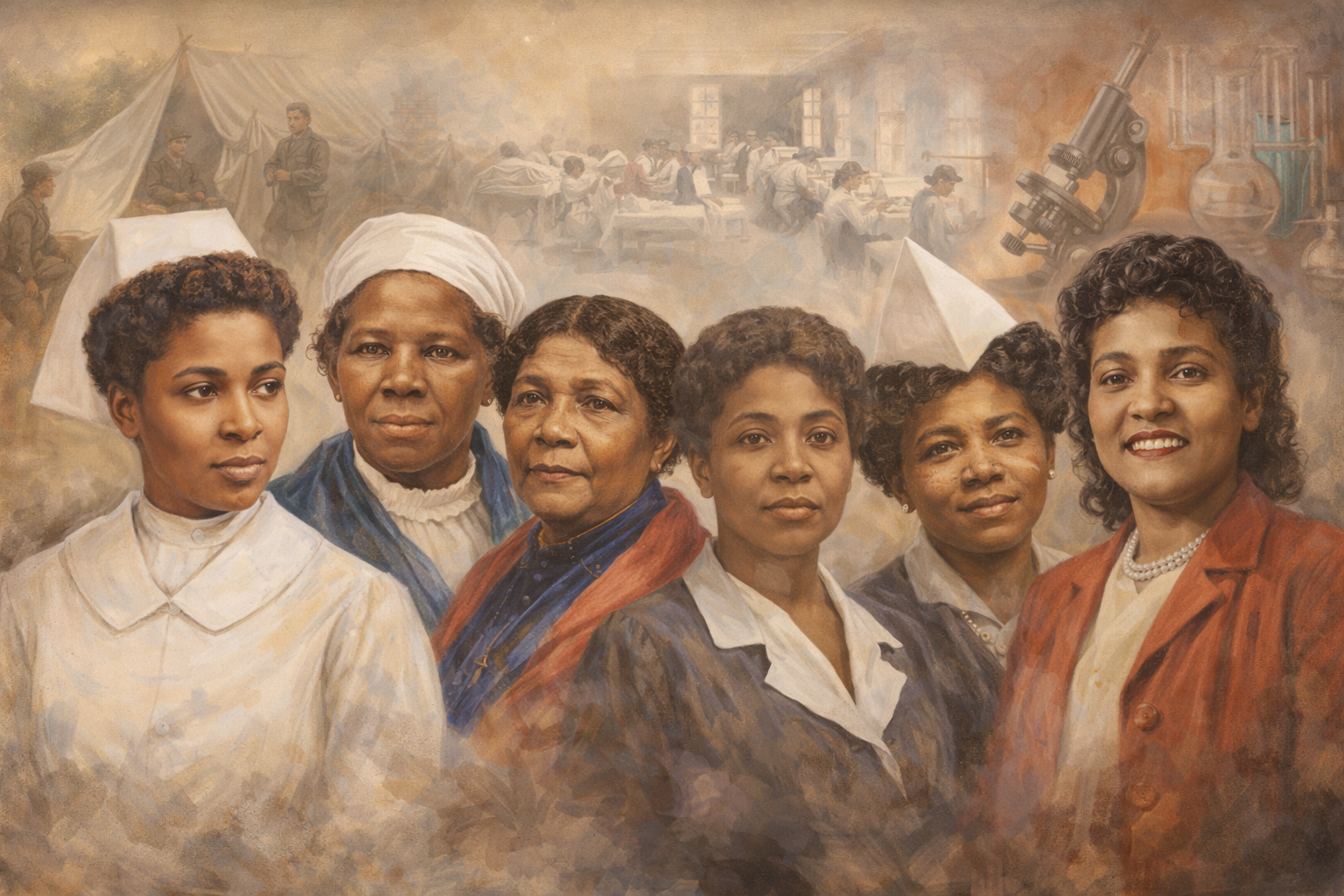
An illustrated collage depicting Black healthcare pioneers from different eras, including nurses, caregivers, and medical contributors, set against historical healthcare scenes and laboratory imagery to represent their enduring influence on patient care and medical advancement.
Black history in healthcare did not begin with access or equity — it began with determination, skill, and service.
Long before doors were opened widely, Black nurses, caregivers, advocates, and patients shaped healthcare through resilience and commitment, often while navigating barriers that made their work harder and their contributions easier to overlook. Their legacy is woven into modern healthcare, whether their names are known or not.
Mary Eliza Mahoney: Setting the Standard
In 1879, Mary Eliza Mahoney became the first African American to earn a professional nursing license in the United States.
At a time when opportunities for Black women in healthcare were extremely limited, Mahoney established a standard of professionalism, competence, and dedication that still defines nursing today. Her legacy reminds us that excellence has always existed — even when recognition did not.
Care Without Permission or Recognition
Healthcare history also includes figures like Harriet Tubman, who served as a Union Army nurse during the Civil War, and Mary Seacole, who provided critical care to soldiers during the Crimean War.
Both women delivered care in environments where racial and gender barriers were the norm. They didn’t wait for systems to change — they stepped in where care was needed most.
Public Health and Advocacy
Jessie Sleet Scales, the first Black public health nurse, helped expand healthcare beyond hospital walls, bringing education, prevention, and support directly into communities.
Adah Belle Thoms, a leader within the National Association of Colored Graduate Nurses (NACGN), fought discrimination in nursing education and employment, helping open pathways for future generations of Black nurses.
Their work laid the foundation for public health nursing, advocacy, and professional equity that continues today.
Henrietta Lacks: A Legacy That Changed Medicine
The story of Henrietta Lacks is one of extraordinary medical impact and ethical reflection.
Her cells — taken without her knowledge or consent — became the first immortal human cell line, contributing to breakthroughs in cancer treatment, vaccines, and countless medical advancements still in use today.
Henrietta Lacks’ story continues to shape conversations around patient rights, consent, trust, and equity in healthcare — conversations that remain essential.
Why These Stories Still Matter
These pioneers didn’t just change history — they influence how care is delivered now.
Their stories remind us that:
healthcare excellence has always existed within marginalized communities
progress requires acknowledgment and accountability
trust in healthcare is built through respect, representation, and integrity
Honoring Black healthcare pioneers means remembering the people behind the progress — not just during Black History Month, but every day.
Valentine’s Day in Healthcare: Compassion Is Still the Heart of the Work

Smiling nurse holding hands with an elderly woman in a nursing home decorated for Valentine’s Day, representing compassion and patient-centered care.
Valentine’s Day looks different in healthcare.
It’s not all chocolates and balloons. It’s caregivers showing up for early shifts. It’s nurses remembering how a resident likes their coffee. It’s aides holding hands, calming nerves, and offering patience on days when emotions run high.
Care doesn’t pause for holidays — but it does feel deeper on days that remind us why the work matters.
Care Is More Than a Task List
In nursing homes and long-term care settings, relationships matter. Residents notice who takes the extra minute. Families remember kindness. Staff feel the weight of responsibility — and the pride that comes with doing meaningful work.
Compassion isn’t always dramatic. Sometimes it’s quiet. Sometimes it’s repetitive. Sometimes it’s simply showing up again, even when you’re tired.
Supporting the Caregivers Matters Too
Valentine’s Day is also a reminder that the people providing care deserve care themselves.
Staff who feel supported:
communicate better
work more confidently
stay longer
When staffing is stable, compassion has room to exist. When teams are stretched too thin, even the most dedicated caregivers feel the strain.
Why Staffing Impacts the “Heart” of Care
Adequate staffing allows caregivers to:
focus on residents, not just tasks
maintain patience and presence
deliver care with dignity
It’s hard to lead with compassion when you’re exhausted. Support systems — including staffing support — help protect the heart of healthcare.
Healthcare isn’t romantic, but it is deeply human.
On Valentine’s Day, it’s worth recognizing the quiet dedication that happens in hallways, rooms, and nurses’ stations every single day — not because it’s a holiday, but because people matter.
What Nursing Facilities Ask Us Most About Staffing (And Honest Answers)
If there’s one thing nursing facilities have in common, it’s this: the questions usually come after a long day.
They’re not theoretical. They’re practical. Sometimes a little stressed. Sometimes whispered like, “I hope this isn’t a dumb question…”
(It never is.)
Here are some of the most common questions facilities ask about staffing — and the real answers.
“What happens if agency staff call off?”
This is usually the first question, and for good reason.
The short answer: call-offs happen everywhere — agency or not. The difference is how they’re handled.
A solid staffing partner already has backup plans in place. That means:
a bench of available staff
clear communication when something changes
and transparency instead of excuses
No system is perfect, but silence is never the answer. Coverage issues should be addressed quickly and honestly.
“How fast can you respond?”
Facilities don’t ask this out of curiosity. They ask because they’ve been burned before.
Response time depends on a few things:
how much notice is given
what role is needed
and how local the staff pool is
Local agencies tend to move faster simply because the logistics make sense. Same time zone. Same region. Less guesswork.
“How do you check credentials and compliance?”
This question usually comes with a pause — because compliance matters, and nobody wants surprises during a survey.
Credential checks typically include:
license verification
background checks
required certifications
ongoing tracking
Facilities shouldn’t have to double-check behind a staffing partner. Trust is built when the process is clear and consistent.
“Is agency staff familiar with nursing homes?”
This one is understated, but important.
Healthcare experience is broad. Long-term care is specific.
Staff who understand nursing home environments know:
routines matter
teamwork is essential
residents aren’t just tasks — they’re people
Fit matters as much as credentials.
“Is this a short-term fix or a long-term solution?”
The honest answer? It can be either.
Some facilities use staffing support:
temporarily, to get through a tough season
strategically, while hiring permanent staff
or ongoing, to maintain flexibility
The goal isn’t dependency. It’s stability.
Staffing questions don’t mean a facility is struggling. Most of the time, they mean leadership is trying to do the right thing — for residents and staff.
And asking questions before a crisis hits?
That’s usually a sign of good leadership.
Common Staffing Challenges in Nursing Homes — And What Actually Helps
Let’s be honest: staffing in nursing homes is rarely quiet.
Even facilities with strong leadership and dedicated teams run into challenges — call-offs, turnover, schedule gaps, and those weeks where everything seems to happen at once. If you’ve ever stared at a schedule thinking “There’s no way this works,” you’re not alone.
Here are some of the most common staffing challenges facilities face — and what tends to help in real life, not just on paper.
Call-Offs That Snowball
One call-off can turn into three. Suddenly someone is working a double, morale dips, and the whole day feels heavier.
What helps:
having a backup plan before the call-off happens
clear communication about coverage expectations
outside support that can step in without drama
No one plans to call off — but planning for it makes all the difference.
Burnout Among Good Staff
This one’s tough, because burnout usually hits your most reliable people first. They care, so they stretch themselves… until they can’t.
What helps:
temporary relief so staff can breathe
realistic scheduling instead of constant overtime
leadership acknowledging the strain (that alone goes a long way)
Sometimes support isn’t about fixing everything — it’s about giving people room to recover.
Hiring Takes Time (Care Doesn’t Pause)
Recruiting and onboarding take longer than anyone wants. Meanwhile, residents still need care today.
What helps:
short-term staffing to stabilize operations
flexibility while permanent roles are filled
avoiding rushed hiring decisions that create bigger problems later
Filling a role fast isn’t always the same as filling it well.
Compliance Pressure
Between documentation, credentialing, and survey readiness, staffing gaps can feel risky — especially when standards don’t loosen just because the schedule is tight.
What helps:
properly credentialed staff
clear role expectations
partners who understand compliance isn’t optional
Nobody wants to explain staffing issues during a survey. Prevention is quieter than damage control.
The Emotional Weight of the Work
This part doesn’t get talked about enough. Nursing home work is meaningful — and emotionally demanding. Residents rely on consistency. Staff build relationships. When staffing is unstable, everyone feels it.
Sometimes the goal isn’t perfection.
Sometimes it’s stability.
And sometimes, getting through a hard week with support is the win.
If staffing challenges feel constant, it doesn’t mean a facility is failing. It usually means the workload is real, the expectations are high, and the people doing the work care.
And honestly? That’s worth supporting.
The Difference Between CNA, CMA, LPN, and RN Staffing — What Facilities Should Know
Understanding the different healthcare roles within a facility is essential when requesting staffing support. While CNAs, CMAs, LPNs, and RNs all play critical roles in patient care, their responsibilities, scope of practice, and training levels differ.
Here’s a clear breakdown to help facilities request the right level of support for their needs.
Certified Nursing Assistant (CNA)
CNAs provide hands-on, direct patient care and are often the backbone of long-term care and nursing facilities.
Typical CNA responsibilities include:
assisting residents with daily living activities
mobility and transfers
bathing, dressing, and feeding
monitoring basic needs and reporting changes
CNAs do not administer medications and work under the supervision of licensed nursing staff.
Certified Medication Aide (CMA)
A CMA is a CNA who has completed additional training and certification to administer certain medications under supervision and within state guidelines.
CMAs may:
pass routine oral medications
follow strict medication administration protocols
CMAs do not perform nursing assessments and are not a replacement for licensed nurses, but they provide valuable support in medication management within long-term care settings.
Licensed Practical Nurse (LPN)
LPNs are licensed nurses who provide clinical care under the supervision of an RN or physician.
LPN responsibilities often include:
medication administration
wound care and treatments
monitoring patient conditions
documentation and communication with care teams
LPN staffing is often requested when facilities need stronger clinical coverage or support for nursing leadership.
Registered Nurse (RN)
RNs have the highest level of clinical training among these roles and are responsible for patient assessments, care planning, and clinical decision-making.
RNs may:
oversee nursing staff
conduct assessments and care coordination
manage complex clinical situations
ensure compliance with care standards
RN staffing is typically used for leadership coverage, higher-acuity care, or regulatory requirements.
Why Role Clarity Matters
Requesting the correct role helps ensure:
appropriate care delivery
regulatory compliance
cost-effective staffing
smoother facility operations
Clear role expectations also reduce confusion and improve collaboration between facility teams and agency staff.
Final Thoughts
Each role serves a distinct purpose, and effective staffing starts with understanding those differences. Facilities that clearly define their needs are better positioned to receive the right support at the right time.
For Kansas nursing facilities, informed staffing decisions help protect care quality, staff morale, and operational stability.
How Healthcare Staffing Agencies Support Kansas Nursing Facilities During Shortages
Staffing shortages are not new in healthcare, but over the past few years, many Kansas nursing facilities have felt the strain more than ever. When positions go unfilled, the pressure doesn’t just fall on administrators — it impacts existing staff, resident care, and overall facility operations.
Healthcare staffing agencies exist to help bridge that gap, but there’s often confusion about what agencies actually do and when it makes sense to partner with one. Here’s a clear breakdown.
Why Staffing Shortages Happen
Nursing facilities experience shortages for many reasons, including:
staff illness or call-offs
vacancies due to turnover
census increases
vacation and leave coverage
difficulty hiring locally
When staffing gaps persist, remaining team members are often asked to work extra shifts, which can lead to burnout and lower morale.
How Staffing Agencies Help
A healthcare staffing agency provides qualified professionals on a temporary or long-term basis to support facility needs. Depending on the situation, agencies may supply:
CNAs and CMAs for direct care and medication support
LPNs or RNs for clinical coverage
short-term coverage for call-offs or emergencies
longer placements while facilities recruit permanent staff
The goal is not to replace internal teams, but to support them so care standards remain consistent.
Flexibility Without Long-Term Commitment
One of the biggest advantages of working with a staffing agency is flexibility. Facilities can request coverage for:
a single shift
a weekend
a short-term assignment
or an extended period
This allows administrators to address immediate needs without rushing hiring decisions or stretching current staff too thin.
Supporting Compliance and Continuity of Care
Reputable staffing agencies verify credentials, licenses, and required documentation before placing staff. This helps facilities maintain compliance standards while ensuring residents receive safe, consistent care.
Continuity matters — residents do better when care is reliable, and staff perform better when they are supported instead of overwhelmed.
When Should a Facility Consider an Agency?
Facilities often reach out when:
overtime becomes the norm
staff morale begins to decline
coverage gaps affect quality of care
recruiting efforts need breathing room
Using an agency proactively can prevent small staffing issues from becoming larger operational challenges.
A Local Approach Matters
Kansas-based staffing agencies understand local regulations, facility expectations, and workforce realities. Being local allows for faster response times, clearer communication, and stronger working relationships.
Final Thoughts
Healthcare staffing agencies are not a last resort — they are a strategic resource. When used thoughtfully, they help protect staff well-being, maintain compliance, and support the quality of care residents deserve.
For Kansas nursing facilities navigating staffing challenges, partnership and planning make all the difference.
2025 Wasn’t the Problem. It Just Showed Us One.
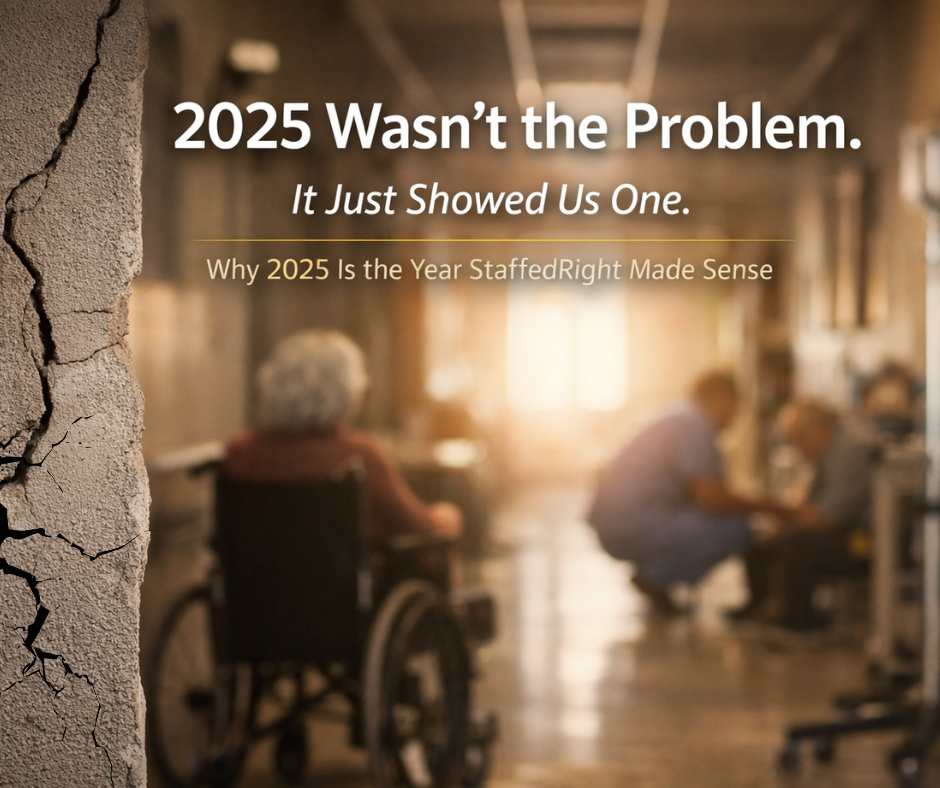
Why 2025 Is the Year StaffedRight Made Sense
StaffedRight Solutions wasn’t created because the healthcare staffing industry needed another agency. It was created because 2025 made something impossible to ignore.
The challenges nursing homes faced this year weren’t new. Staffing shortages, oversight gaps, burnout, and accountability pressures had existed long before. But in 2025, those cracks became harder to cover — and harder to work around.
Facilities weren’t just filling shifts anymore. They were managing risk, protecting residents, and holding systems together with fewer resources and higher expectations.
That reality is what made StaffedRight make sense.
What Facilities Endured in 2025
For many nursing homes, 2025 felt like operating in a constant state of readiness.
Oversight didn’t disappear, but it became inconsistent. Inspections were delayed. Feedback loops slowed. Yet expectations didn’t ease. Facilities were still held to standards around resident safety, documentation, and quality of care — often without timely guidance or support.
At the same time, staffing shortages continued to strain operations. Burnout remained high. Turnover stayed steady. And when coverage gaps occurred, facilities were left managing the downstream impact on residents, families, and compliance requirements.
Administrators weren’t just solving staffing problems. They were carrying the weight of systems that required more than they were giving.
Staffing Was the Common Thread
If 2025 revealed anything clearly, it was that staffing sits at the center of nearly every challenge facilities faced.
Missed care, documentation issues, and resident complaints were often tied to inconsistent coverage. Involuntary discharges were frequently connected to staffing instability. And when staff were stretched too thin, the quality of care — and the resident experience — suffered.
Facilities weren’t struggling because they didn’t care. They were struggling because the margin for error had disappeared.
In that environment, staffing agencies became more than vendors. They became extensions of a facility’s reputation, compliance posture, and risk exposure.
Oversight Without Margin for Error
Even with inspector shortages and delayed surveys, accountability didn’t soften in 2025.
Facilities were expected to remain survey-ready at all times. Resident rights, safety protocols, and documentation standards still applied — regardless of staffing challenges or oversight delays.
The absence of frequent inspections didn’t mean leniency. It meant facilities had to self-police, self-correct, and stay compliant without consistent external checkpoints.
In that reality, who showed up on the floor mattered more than ever.
Unprepared staff, poor communication, and unreliable coverage didn’t just create inconvenience — they created exposure.
What 2025 Taught Facilities About Staffing Partnerships
By the end of 2025, many facilities had learned hard lessons about what they truly needed from staffing partners.
They needed reliability over volume.
Communication over speed.
Accountability over excuses.
Preparation over placement.
Facilities needed staffing partners who understood compliance pressures, respected facility culture, and recognized that every shift carried real consequences — for residents, staff, and the organization as a whole.
Transactional staffing models fell short. Relationship-based partnerships became essential.
Why StaffedRight Exists
StaffedRight Solutions was built in response to these realities.
Not to move faster, but to move more responsibly.
Not to fill shifts at any cost, but to staff with intention.
Not to add noise, but to bring clarity and accountability back into the process.
We believe staffing is no longer just an operational function. It’s a trust-based partnership that directly impacts care, compliance, and outcomes.
Carrying These Lessons Forward
The challenges facilities faced in 2025 didn’t end when the calendar turned. They carried forward — into how staffing is evaluated, how oversight is navigated, and how accountability is measured.
StaffedRight Solutions exists for facilities that want to do things the right way — even when the system makes it hard.
Because 2025 wasn’t the problem.
It simply showed us one.
Holiday Visits, Dirty Hands & Auntie’s Overcooked Ham: A Real Guide to Keeping Elderly Loved Ones Safe This Season

The holidays are here — which means love, laughter, and at least one family member who still refuses to wash their hands after sneezing into them.
Now normally, we’d just judge quietly and keep it moving…
But when you’ve got elderly parents, grandparents, or immunocompromised loved ones, flu season hits different.
So let’s talk real-life, down-to-earth safety tips for keeping your seniors safe during holiday gatherings — with a side of humor, because otherwise we might cry.
1. “Don’t Come In Here Sick” Is Not Rude — It’s Love
If someone shows up coughing like an old car with no muffler, it is absolutely okay to turn them around at the door.
This is not the season for:
“It’s just allergies.”
“I took some DayQuil, I’m fine.”
“I only had a fever yesterday.”
No, ma’am. No sir.
This is the season for protecting our elders, because flu, RSV, and COVID hit them harder.
SEO phrase: holiday illness prevention for seniors
2. Your Kids Are Cute — They Are Also Germ Factories
Kids will sneeze directly into the air and then reach for Grandma’s face like they’re blessing her.
Bring hand sanitizer.
Use it.
Use it on the kids.
Use it on the adults who act worse than the kids.
PRO-TIP: Seniors LOVE kids. Love them.
If you bring them to a nursing home, please supervise so they don’t touch everything like it’s an obstacle course.
SEO phrase: bringing kids to nursing homes during holidays
3. Wipe Down the Table… Especially If Uncle Melvin Is Coming
If your family is anything like mine, someone is going to:
“sample” the food with their fingers
double dip
lick the spoon
cough directly over the ham
Sanitize surfaces.
Serve with utensils.
And please — for the love of all things holy — don’t let nephew Jacobi mix the punch unsupervised.
SEO phrase: holiday food safety for seniors
4. Keep Their Medications on Schedule, Even If the Family Is Not
The family might be running on “we get there when we get there” time, but seniors need consistency.
Especially with:
heart meds
diabetes meds
blood pressure meds
pain management
Set alarms if you need to.
Be the responsible one.
(This is why you’re the favorite.)
SEO phrase: medication management for elderly during holidays
5. Make Your Seniors Laugh — It Boosts Their Health Too
Look, the holidays can be lonely for elders who’ve lost spouses, mobility, or independence.
You know what helps?
Showing up
Bringing kids
Bringing cookies
Letting them tell the same story they told last year
Making them laugh until their shoulders shake
And yes — bring the cookies.
Especially if they’re the good kind, not the dry ones from the Dollar Tree tin.
SEO phrase: emotional wellness for seniors during holidays
6. Test Before Visiting If You Can
Not everybody has access, and that’s okay.
But if you can test for flu or COVID before visiting grandma — do it.
It’s 30 seconds that could save them a hospitalization.
SEO phrase: preventing illness in elderly loved ones
7. And Finally… Don’t Forget the Staff
If your loved one lives in a nursing home, assisted living, or receives in-home care —
show love to the caregivers this season.
Trust me:
A box of cookies + a thank you + maybe even a $5 Starbucks gift card?
You just made somebody’s whole week.
holiday safety tips for seniors, flu season tips, protecting elderly family members, caregiving during holidays, infection control for seniors, nurse staffing agency Kansas, in-home care tips, Wichita healthcare staffing, holiday family visits senior homes
Real People. Real Struggles. Real Strength.
Lately, I’ve been thinking about how heavy life feels for so many of us. Prices are higher, hours are longer, and for a lot of people, help feels harder to reach. Some families are still waiting on their SNAP benefits to hit, trying to stretch whatever’s left in the pantry until they do. Others are calling every childcare center in town, praying for an opening that doesn’t cost half their paycheck. And somehow, through all that, people still show up to care for others.
These are real people, not statistics. Moms, dads, aunties, grandparents, caregivers. The ones holding everything together when it feels like everything is falling apart. They show up tired, sometimes hungry, sometimes heartbroken, but still manage to comfort someone else’s parent or child. That kind of strength deserves more respect than the world gives it.
I see you. I see the mom clocking out from a night shift only to rush her kids to school before she can rest. I see the dad sitting in his car before work, checking his bank account and wondering how to make the week stretch. I see the caregiver who is always there for everyone else, even when no one asks how she’s doing. You are not invisible, and you are not alone.
At StaffedRight Solutions, we believe in grace before judgment. We understand that people can’t pour from an empty cup. That a schedule is more than numbers on a page. It’s a reflection of someone’s life, their responsibilities, and their sacrifices. We don’t just fill shifts. We see people. We listen. We care.
To every person out there doing the best they can with what they have, keep going. You are seen. You are valued. And you matter more than you know.
From one human to another,
Nicki B.

Why W-2 Healthcare Staffing Works Better for Facilities (and Nurses Too)
The difference between showing up and showing out? W-2 staffing. Here's why Kansas facilities are choosing healthcare pros who move like a unit — not a gig.
When you're running a facility, you need people who actually show up. On time. In uniform. Ready to work. That’s the standard — but let’s be real, not every agency delivers on that. At StaffedRight Solutions, we don’t just fill shifts. We place W-2 professionals who take pride in what they do. And yes, there’s a difference. Here’s why W-2 staffing changes the game — for everyone.
1. W-2 Staff Are Already Locked In
Every CNA, LPN, or CMA on our roster is background checked, cleared, and paperwork-ready. TB test? Done. CPR card? Uploaded. References? Verified.
So when we say someone’s booked for your shift, they’re booked and already halfway to the floor.
2. No Tax Drama, No Guesswork
Facilities love that we handle the payroll. Nurses love that they don’t have to figure out 1099 taxes or wonder if they’re covered if something goes wrong on shift.
W-2 staffing means we cover insurance, workers comp, and all the compliance steps. That’s our responsibility, not yours.
3. We Stay Accountable — to Both Sides
When you’re a W-2 with StaffedRight, your name means something. We follow up, we check in, and we step in when someone’s off their game. That’s why our team gets respect — and why facilities trust us over the others.
Because showing up isn’t just clocking in. It’s energy, presence, and consistency.
4. It's About Culture, Not Just Coverage
Our nurses aren't bouncing between apps trying to piece together a paycheck. They're part of something. They know we’ve got their back, so they bring their best to the people they serve.
When you value the staff, the staff values the shift. And when both sides win, your residents feel the difference.
We’re not just a staffing agency. We’re a standard.
If you're tired of agencies that disappear after the confirmation text, or staff who come in like it's their side hustle, let's talk. We'll cover the next shift and show you what it means to be StaffedRight.
✅ W-2 only
✅ Wichita-based
✅ Ready to work
📞 Call 316-257-2999
📧 Email info@staffedrightsolutions.com

Medicaid, Medicare, and Mayhem: What Every CNA & Facility Should Know.
Medicare and Medicaid aren’t just line items — they’re lifelines. Here’s why Kansas healthcare facilities and staffing agencies need to stay alert.
Let’s be honest — trying to understand Medicaid and Medicare is like trying to read a medical bill with your eyes closed. Whether you're a CNA showing up for your night shift or a facility scheduler juggling twelve open slots, healthcare coverage impacts you more than you think.
And lately? The system’s giving chaos.
So What’s the Difference, Anyway?
Let’s break it down without sounding like a textbook:
Medicare: This is federal. Think seniors 65+ and some people with disabilities. If Grandma just had hip surgery, Medicare probably helped cover it.
Medicaid: This is state-run and helps low-income individuals (young and old) cover medical costs. In Kansas, Medicaid is also called KanCare — and it’s how a lot of long-term care gets funded.
Most skilled nursing and rehab facilities rely on a mix of both. But here's the kicker — when reimbursements get delayed or slashed, everyone feels it.
How This Impacts Staffing (a.k.a. You)
When Medicaid cuts rates or tightens the rules, facilities start to panic.
Schedulers get told to “cut hours.”
CNAs are sent home early or called off.
Nurses stretch thin across more patients.
Morale takes a dive — and patient care suffers.
And that’s exactly where agencies like StaffedRight Solutions come in.
Why Facilities Are Turning to Agencies (Even If They Don’t Wanna Admit It)
We get it — not every administrator wants to use agency staff. But what’s the alternative? Running short? Overworking loyal employees until they burn out?
Here’s the reality:
Medicare and Medicaid changes are unpredictable. Staffing doesn’t have to be.
At StaffedRight, we:
Provide fully cleared W-2 CNAs, LPNs, and CMAs who are ready to work
Understand how reimbursements affect your census
Offer coverage that doesn’t complicate your budget
Step in when last-minute needs become a daily thing
For CNAs Wondering Why Their Hours Got Cut…
It’s not personal. It’s politics and paperwork.
But we know you’ve still got bills, goals, and people depending on you.
That’s why we treat our team like humans — not just fill-ins.
Because even if the system is broken, the people don’t have to be.
In a World Full of Mayhem, We Choose Mission
We know how frustrating it is when funding gets tight, when rules change with no notice, and when the pressure to “just figure it out” falls on already exhausted shoulders.
But that’s why StaffedRight exists — not to complain about the system, but to be part of the solution.
We’re here to staff smarter, support caregivers, and help facilities breathe a little easier.
Because healthcare deserves better.
So if you're tired of the chaos?
Call us. Let’s calm the mayhem — together.

It’s not RIGHT but it’s okay…
Sometimes the best things are built in the middle of the worst moments. StaffedRight Solutions wasn’t created to compete — it was created to correct. This is the story of how a calling became a company, and why doing the right thing will always be the standard.
It’s Not Right, But It’s Okay
The Story Behind StaffedRight Solutions
Not every business starts with a big investor or a fancy boardroom.
Some begin with a breaking point.
StaffedRight Solutions wasn’t created because everything was going well.
It was built because too many things weren’t.
When Leadership Stops Listening
In healthcare staffing, the people doing the work — CNAs, LPNs, CMAs, nurses — are everything. But somewhere along the way, I watched those same people get overlooked.
Schedules were full, but support was missing.
Paychecks were delayed, but accountability was never late.
Voices were silenced in meetings where only power mattered.
And through all of that, caregivers still showed up. Still gave their all.
But I knew in my heart — it wasn’t right.
I started StaffedRight not out of bitterness, but out of purpose.
Because God didn’t bring me this far to stay quiet in rooms that never cared to listen.
Building Something That Feels Different
This agency isn’t just a logo or a shift list — it’s a promise.
A promise that doing the right thing still matters.
That CNAs deserve more than pizza parties.
That nurses deserve to be heard — not just scheduled.
At StaffedRight, we lead with fairness, respect, and real transparency.
We hire W-2 professionals and treat them like humans, not headcounts.
When someone joins us, they’re not “just covering a shift” — they’re carrying legacy.
A Letter to the Ones Who Keep Showing Up
To the caregiver who stayed late even when no one noticed —
To the nurse who drove across town to make sure a resident was okay —
To the facility leader trying to do right by their team in a system that’s breaking —
This is for you.
You are not disposable.
You are not invisible.
And you deserve to work with people who see you clearly.
We’re Not Just a Staffing Agency. We’re a Standard.
StaffedRight Solutions is here to shift the culture — not just fill shifts.
We’re not perfect. But we are present.
We are accountable. We are led by purpose.
And we believe in honoring care the way it’s meant to be: with excellence, compassion, and consistency.
This isn’t about revenge. This is about redemption.
Let’s raise the bar.
Let’s give flowers to the caregivers who earned them.
Let’s staff the right way — StaffedRight.
With respect and heart,
T. Drake
Founder & CEO, StaffedRight Solutions

How to Find Dependable CNA Staffing in Wichita
Wichita healthcare leaders are tired of last-minute call-ins and unreliable agencies. This guide breaks down how to find dependable CNAs who show up ready—every time.
Finding dependable CNAs isn’t just about filling a schedule. It’s about protecting patient care, your team’s sanity, and your facility’s reputation. In Wichita — where the need is real and the options are plenty — it matters who you trust to send help.
At StaffedRight Solutions, we’ve heard it all:
“We had an agency nurse cancel 20 minutes before shift.”
“We can’t even get a call back, let alone someone to show up.”
“We just need one CNA. Why is that so hard?”
We get it. You’re not asking for miracles — just a CNA who shows up on time, in uniform, and ready to work. Here’s what to look for when choosing a healthcare staffing agency in Wichita, and why StaffedRight is leading the way.
1. Start with Local
Big national agencies treat your facility like just another number. Local staffing partners (like us) are in it with you. We know Wichita, we know your residents, and we know how Kansas compliance works — no learning curve needed.
When a CNA no-shows, we’re not passing you off to a call center. You get our real number, and we fix it. Fast.
2. Look for W-2 Staffing — Not 1099
W-2 CNAs are employees, not just contractors. That means:
Background checks and licensing are already cleared
Professional standards are in place
You’re protected from liability and surprise walkouts
It’s structure that holds the team accountable — and it’s how we staff every single CNA we send out.
3. Ask About Their “No-Show” Policy
A dependable CNA isn’t just about showing up on Day 1. It’s about having a real plan if they can’t.
At StaffedRight, we confirm every shift, offer backups when available, and we follow up before you even have to ask. That’s not extra — that’s just the job.
4. Check for Communication & Care
If you have to chase down an agency, you’re already doing too much.
We keep communication simple:
Text, email, or call — we respond.
Need help after hours? We’re still here.
Want transparency? We’ll tell you what’s real — even if it’s not what you want to hear.
Because trust doesn’t come from words. It comes from showing up.
5. Test with One Shift
Not ready to commit? That’s fair. The best way to know if a CNA staffing agency is dependable is to let them prove it.
We offer trial shifts so you can see the difference:
No pushy sales calls
No long-term contracts
Just one great CNA — on time, on task, and on point
Let’s Make Staffing Easier
You don’t need to settle. You don’t need to stress. And you definitely don’t need to overpay for inconsistent results.
Whether it’s one shift or a full schedule, StaffedRight Solutions is ready to step in. We’re local. We’re built different. And we’re here to make your job easier.
📞 Call: 316-257-2999
📧 Email: info@staffedrightsolutions.com
🌐 Visit: www.staffedrightsolutions.com